Gistia Appeal Management PortalAgentic appeal preparation

Keep every appeal connected to the evidence and next action.

Configure denial intake, evidence, deadlines, review, and payer responses around your appeal process. Gistia implements AI agents for case preparation, correspondence drafts, and follow-up under your reimbursement team’s rules and approvals. Available as a standalone module or with Gistia LIMS.

Use your business email. Free and disposable addresses are not accepted. By continuing, you agree that Gistia may contact you about this product. Privacy policy.

Explore the product
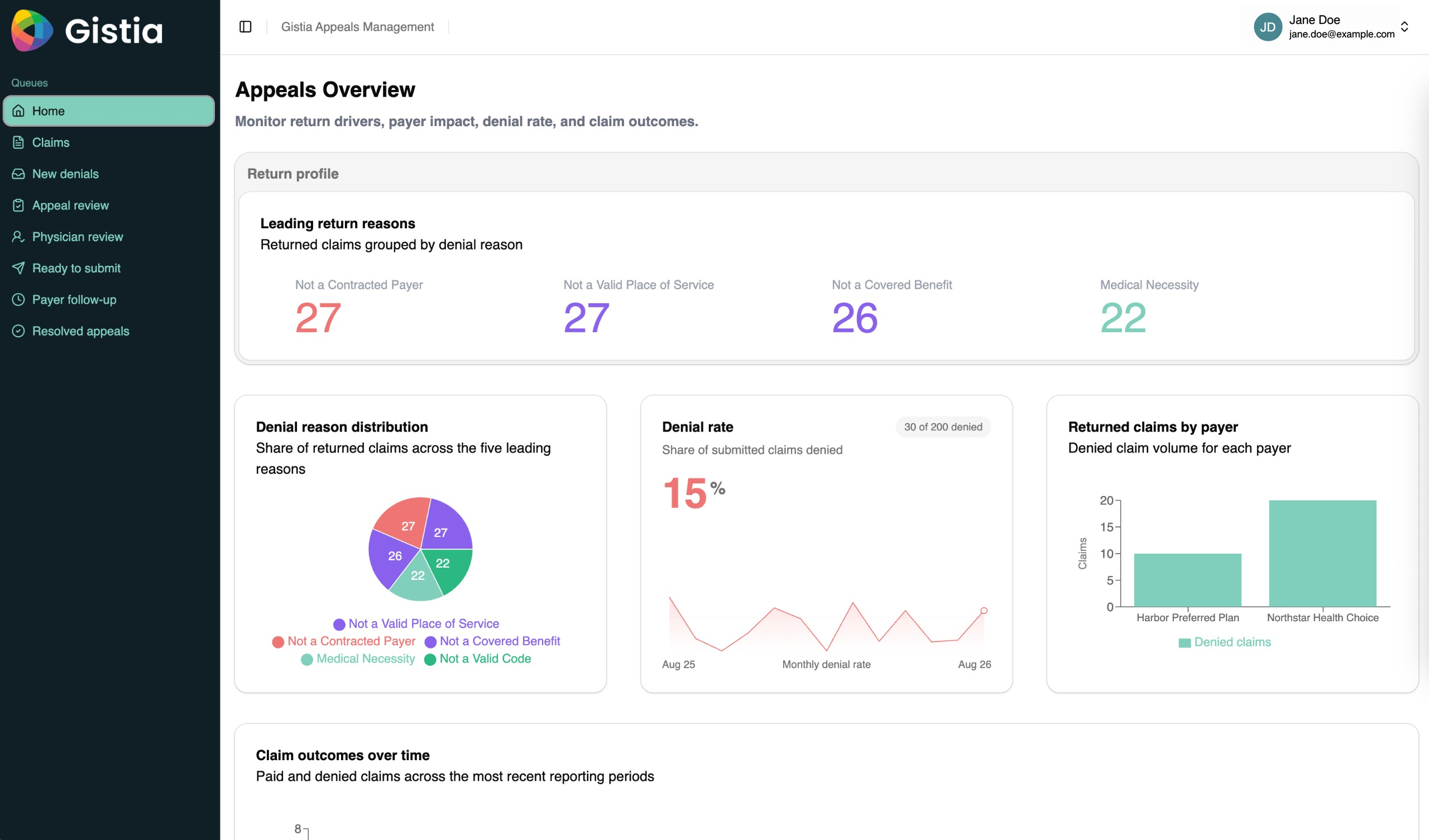
Gistia Appeal Management overview with appeal cases and status information.
Appeal overviewKeep every case, deadline, and next action visible.

Product experience

See the case from denial signal to appeal outcome.

The product views show portfolio priorities, denial and outcome analytics, and the complete claim record with supporting appeal correspondence.

Gistia Appeal Management overview with appeal cases and status information.Appeal overview
01Portfolio overview

Know which appeal needs attention and why.

See leading return reasons, denial rate, active work, claim outcomes, payer context, and the cases that need follow-through.

  • Surface active volume and current state
  • Prioritize by reason, payer, and deadline
  • Keep ownership and next action visible
Replace ad hoc follow-up with a shared operational queue.
AI agents in this workflowDenial Intake Agent
Take the interactive demo
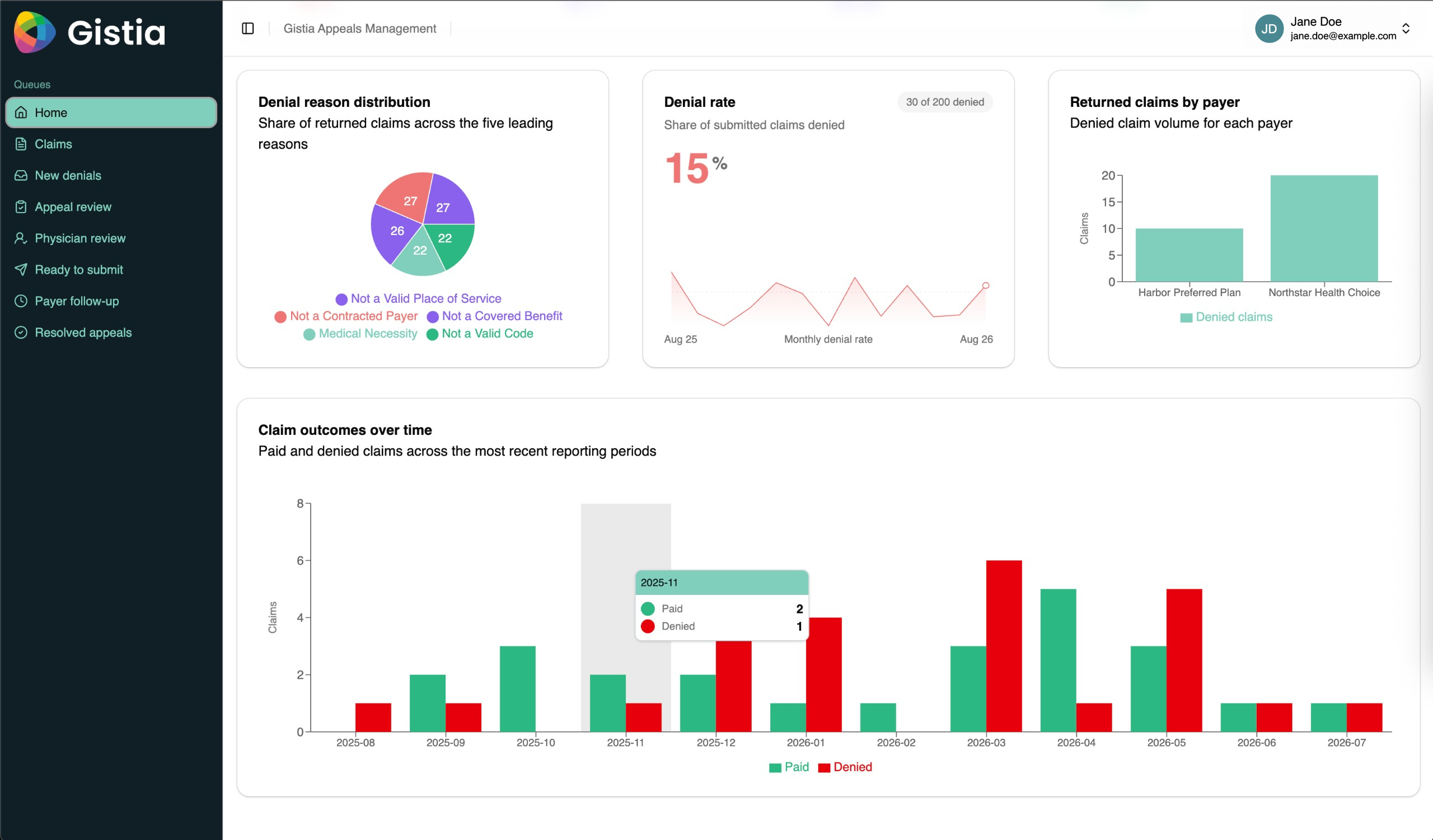
Gistia Appeal Management analytics with appeal performance metrics.Appeal analytics
02Denial intelligence

Find the patterns behind the appeal workload.

Compare denial distribution, historical trends, reasons, payers, and outcomes to identify where intervention can have the greatest effect.

  • Measure denial and appeal trends
  • Compare reasons and payer patterns
  • Track outcomes and operating performance
Use appeal evidence to improve both reimbursement work and upstream processes.
AI agents in this workflowPayer Response Agent
Take the interactive demo
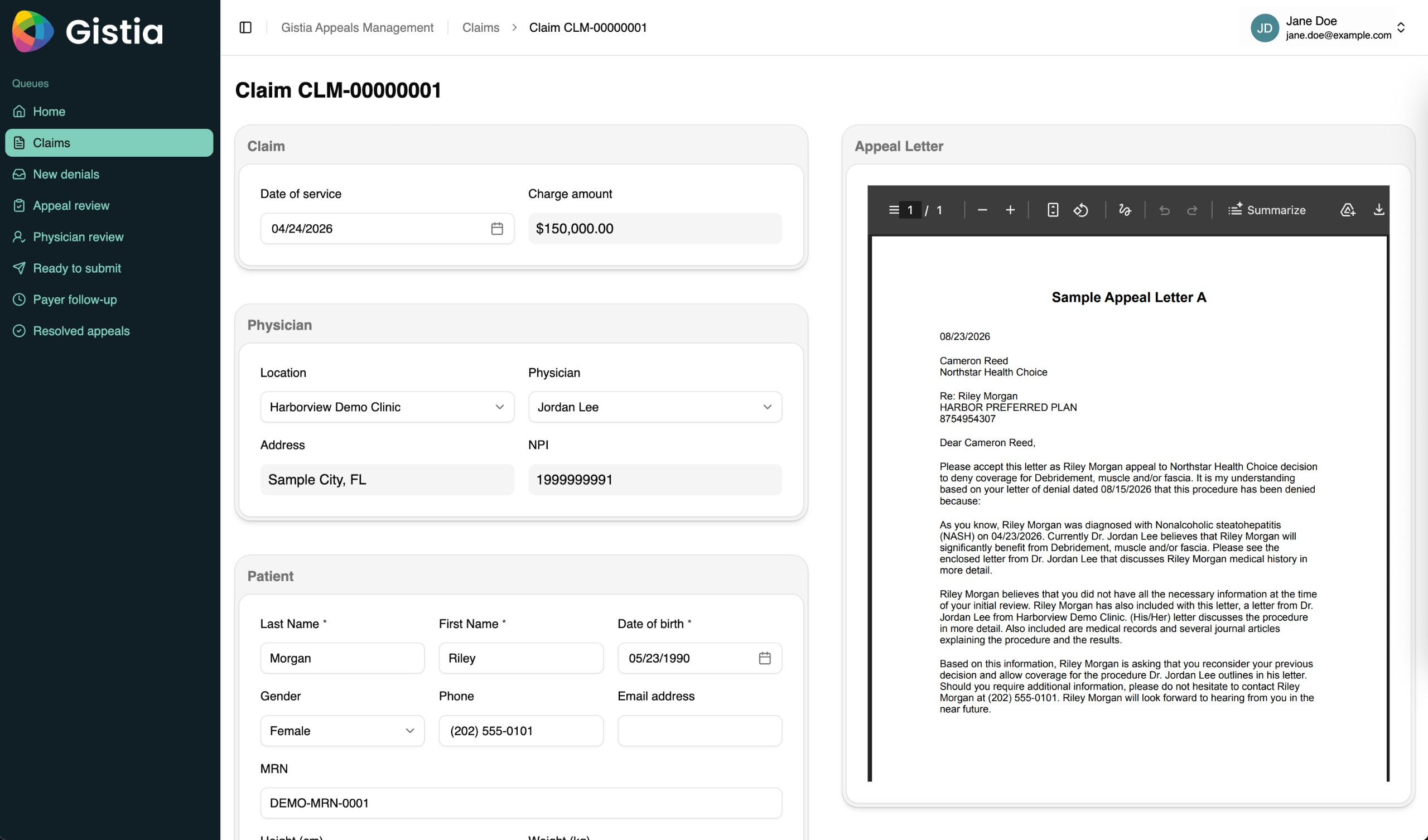
Gistia Appeal Management claim review with supporting evidence and appeal letter.Claim review
03Case review

Review the claim and appeal letter in one record.

Keep patient, provider, claim, denial rationale, supporting documentation, and the generated or uploaded appeal communication side by side.

  • Connect source claim and case context
  • Review evidence and rationale
  • Prepare, approve, and preserve correspondence
Give reviewers the complete case without searching across separate tools.
AI agents in this workflowAppeal Preparation Agent
Take the interactive demo
  1. 01Prioritize the caseSee the denial reason, deadline, value, and current state.
  2. 02Build the evidenceConnect claim, clinical, policy, and correspondence support.
  3. 03Review and submitKeep ownership, document preparation, approval, and payer follow-up together.
  4. 04Close the outcomeRecord the payer decision and use patterns to improve future work.

What you get

Turn scattered denial follow-up into an accountable appeal operation.

The portal connects the case, owner, deadline, evidence, appeal letter, payer response, and final outcome so teams can prioritize work and learn from results.

Prioritization

Focus on the cases that need action.

Use denial reason, value, deadline, status, and ownership to make the active appeal workload visible.

Case strength

Keep rationale and support together.

Connect claim data, clinical evidence, payer policy, correspondence, and the appeal document in one case.

Learning

See what drives denials and outcomes.

Compare return reasons, payer patterns, appeal volume, and resolution trends across the operation.

Product capabilities

Organize appeal operations around the case, not scattered follow-up.

Configure queues, evidence, ownership, deadlines, correspondence, review, payer response, and outcome tracking around the organization’s appeal model.

Focused capabilityGistia Appeal Management Portal
Appeal case reviewKeep the evidence, deadline, and next action together.

Illustrate the working record teams use to move a denied claim toward a documented outcome.

Take the interactive demo
Case intake

Create a usable appeal record.

Capture denial reason, payer, claim, value, deadline, priority, source records, and qualification state.

Evidence

Keep the rationale and support connected.

Bring together clinical documentation, payer policy, prior communication, notes, and supporting attachments.

Correspondence

Coordinate review and submission.

Prepare appeal letters, preserve versions, assign reviewers, capture approval, and track payer follow-up.

Outcomes

Measure decisions and recurring patterns.

Record resolutions and compare volume, reasons, payer behavior, turnaround, and recovered outcomes.

Connected operating path

A traceable path from denial signal to resolved appeal.

Keep every case connected to its evidence, responsible owner, submission history, payer response, and final decision.

01Qualify

Prioritize the case

Capture the denial, value, deadline, reason, and evidence required to proceed.

02Build

Assemble the record

Connect the claim, clinical documentation, payer policy, rationale, and prior correspondence.

03Coordinate

Review and submit

Assign ownership, prepare the appeal, complete review, submit, and track payer follow-up.

04Close

Record the outcome

Preserve the decision and use patterns to improve future appeals and upstream processes.

AI agents for your workflow

AI agents for appeal preparation and follow-up.

Choose an agent to compare its incoming information with the work it prepares for your team.

Denial intake

Denial Intake Agent

Structure the case.

Extract denial reasons, dates, and requested information from correspondence and connect them to the source.

Illustrative example · APL-312

Ready for team review

Incoming information

Denial and appeal case record

Payer correspondence
Supporting order documentation requested
Required order record
Order record attached
Case deadline
Within the example case's recorded deadline
Case owner
Authorized reimbursement reviewer

AI-prepared work

Structure the payer's request.

Denial summary
Payer requests order documentation. Connect the request to APL-312 and its recorded deadline.
Evidence context
Requested order record is attached for review.

Required evidence must be attached

The required order record is present and the case is within its recorded deadline.

Next stepReimbursement team: record approved appeal packet.

When required information is missing

Attach the missing order record before approving the appeal packet. Keep the case with its reimbursement owner.

Payer response

Payer Response Agent

Prepare the next action.

Summarize the response, identify unresolved requests, and route follow-up to the case owner.

Illustrative example · APL-312

Ready for team review

Incoming information

Denial and appeal case record

Payer correspondence
Supporting order documentation requested
Required order record
Order record attached
Case deadline
Within the example case's recorded deadline
Case owner
Authorized reimbursement reviewer

AI-prepared work

Prepare the payer follow-up.

Response brief
Documentation request remains open until the reviewed packet is submitted and the payer responds.
Next task
Reimbursement owner approves the evidence packet and tracks the next payer response.

Required evidence must be attached

The required order record is present and the case is within its recorded deadline.

Next stepReimbursement team: record approved appeal packet.

When required information is missing

Attach the missing order record before approving the appeal packet. Keep the case with its reimbursement owner.

We implement these tasks in Gistia Flow and test the rules, model outputs, exception paths, and approvals before launch. Authorized teams approve appeals and submissions. Coverage and payment decisions remain with the payer.

Implementation and support

Configure, validate, launch, and keep improving.

One accountable team connects case design, evidence sources, payer correspondence, validation, launch, reliability, and controlled improvement.

01Configure

Fit the product to the appeal operation.

Map case types, evidence, owners, deadlines, review states, correspondence, outcomes, measures, and integrations.

02Validate and launch

Prove the full case lifecycle.

Test representative appeals and exceptions, validate records and communication, prepare teams, and support go-live.

03Operate and improve

Keep appeal work accountable.

Monitor queues and integrations, resolve issues, govern changes, and improve the operation from case outcomes.

Continuing accountabilityOperate · Improve · Extend

Keep appeal work reliable, improve it from case and outcome evidence, and extend it when the next reimbursement need is justified.

See the shared Gistia Flow foundation

Make every appeal an accountable operating record.

Bring your denial sources, case types, evidence, review model, payer correspondence, deadlines, and outcome measures.